Virginia Tech® home

Crop Physiology

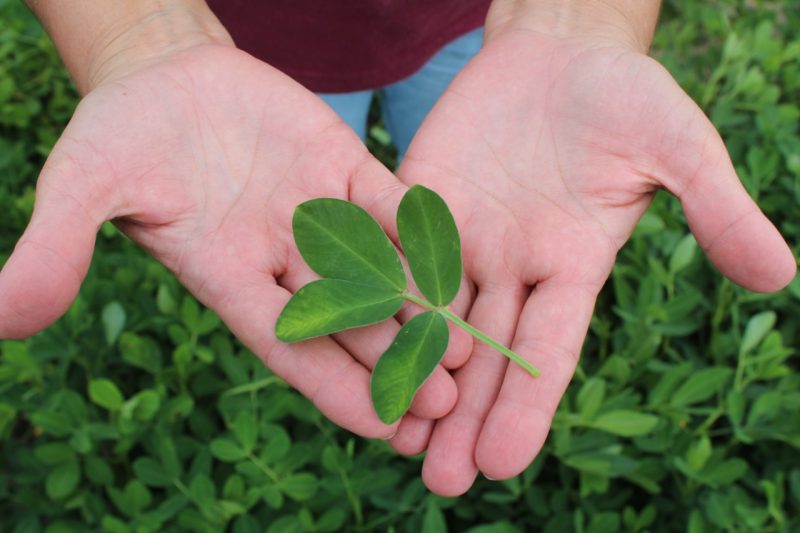
hands holding peanut leaves

The overall goal of  the crop physiology research is to improve production systems' sustainability in Virginia and mid-Atlantic region. This has been accomplished through research addressing abiotic stress adaptation of field crops and development of high-throughput phenotypic methods, and participation in nationally recognized Multi-State Hatch projects, S 1069 and S 1079.

The research focusses on phenomics of the currently grown crops, with emphasis on peanut, and future crops to fit the Commonwealth environment. Employing direct and aerial measurements of the plant physiological, morphological, and agronomic characteristics, this research determined that water is undoubtedly a significant factor limiting yield in the sub-humid Virginia, where each degree Centigrade increase in temperature (5˚C increase is expected by 2080) can reduce peanut yield by 11%.

Additionally, Dr. Balota and her team are piloting a $2.7 million multistate project funded by the U.S. Department of Agriculture's National Institute of Food and Agriculture Specialty Crops Research Initiative to introduce the faba bean as a sustainable fall and winter crop in the mid-Atlantic region. 

Faba bean plants in bloom

Professor Maria Balota is piloting a $2.7 million multistate project funded by the U.S. Department of Agriculture's National Institute of Food and Agriculture Specialty Crops Research Initiative to introduce the faba bean as a sustainable fall and winter crop in the mid-Atlantic region. 

Read more: Faba Bean: A Multipurpose Specialty Crop for the Mid-Atlantic USA

Field Notes - February 2026 Update:

  • Legumes play important role for soil regeneration in agricultural cropping systems.
  • These faba beans (Vicia faba L.) were planted on Oct 27, 2025, and will be ready to harvest at the end of May or early June 2026. As a crop with winter hardiness like winter wheat, faba bean can strategically enhance the farm profit if planted as a winter crop for dry seed production.
  • Several faba bean varieties with outstanding winter hardiness have been identified and, currently, their seed is being increased at the Tidewater and Eastern Virginia Agricultural Research & Extension Centers. Additional data on their winter hardiness and yield is being collected in Jan and Feb 2026.
  • Concurrently, crosses for high yield and reduced seed size are being conducted in the greenhouse at Tidewater AREC.

 

Journal articles:

2026

  • Koduru, S., Sadeghpour, A., Cazenave, A.-B., Aguilar, C., Oakes, J., Davies, B., Mehl, H. L., & Balota, M. (2026). Optimizing preplant nitrogen rate for early versus late biomass sorghum in the US Mid-Atlantic. Agronomy Journal, 118, e70288. https://doi.org/10.1002/agj2.70288

2025

  • Singh, M., Balota, M., Huang, H., O’Keefe, S., & Carneiro, R. (2025). Faba Bean: Unlocking Nutritional Potential and Agricultural Sustainability. Current Research in Food Science, 101136. https://doi.org/10.1016/j.crfs.2025.101136
  • Balota, M., Boote, K., Dean, L. L., Sanz-Saez, A., Pilon, C., Cazenave, A., Zurweller, B., and Payton, P. (2025) “Peanut Physiology and Tolerance to Abiotic Stresses”, Peanut Science 52(2), p.17-56. doi: https://doi.org/10.3146/0095-3679-52.2-PS1632.
  • Sahayaraj, S.R.E., Chandel, A.K., Balota, M., Chappell, M. and Sridhar, V., 2025, May. Leveraging stacked generalization for peanut maturity mapping using aerial multispectral imagery and growing degree days. In Autonomous Air and Ground Sensing Systems for Agricultural Optimization and Phenotyping X (Vol. 13475, pp. 202-212). SPIE.
  • Jjagwe, P., Chandel, A., Balota, M. and Raman, R., 2025, May. Faba bean crop plant identification using aerial multispectral imagery and convolutional neural network-based deep learning models. In Autonomous Air and Ground Sensing Systems for Agricultural Optimization and Phenotyping X (Vol. 13475, pp. 227-236). SPIE.

2024

  • Kumar, N., Haak, D.C., Dunne, J.C., Balota, M. (2024). Phenotypic dissection of drought tolerance in Virginia and Carolinas within a Recombinant Inbred Line population involving a spanish and a virginia-type peanut lines. Agriculture 2024, 14, 908. https://doi.org/10.3390/agriculture14060908.
  • Balota, M.; Sarkar, S*.; Bennett, R.S.; Burow, M.D. (2024). Phenotyping Peanut Drought Stress with Aerial Remote-Sensing and Crop Index Data. Agriculture 2024, 14, 565. https://doi.org/10.3390/agriculture14040565.
  • Chapu, I*.; Chandel, A.; Sie, E.K.; Okello, D.K.; Oteng-Frimpong, R.; Okello, R.C.O.; Hoisington, D.; Balota, M. (2024). Comparing Regression and Classification Models to Estimate Leaf Spot Disease in Peanut (Arachis hypogaea L.) for Implementation in Breeding Selection. Agronomy 2024, 14, 947. https://doi.org/10.3390/agronomy14050947
  • Seidu, A.; Abudulai, M.; Dzomeku, I.K.; Mahama, G.Y.; Nboyine, J.A.; Appaw, W.; Akromah, R.; Arthur, S.; Bolfrey-Arku, G.; Mochiah, M.B.; et al. (2024). Evaluation of Production and Pest Management Practices in Peanut (Arachis hypogaea) in Ghana. Agronomy 2024, 14, 972. https://doi.org/10.3390/agronomy 14050972
  • Oakes, J*., Balota, M., Cazenave, A. -B., & Thomason, W. (2024). Using Aerial Spectral Indices to Determine Fertility Rate and Timing in Winter Wheat. Agriculture, 14(1), 95. doi:10.3390/agriculture14010095 Published online: 2024-01-03.
  • Jordan, D. L., Anco, D., Balota, M., Langston, D., Lux, L., Shew, B., & Brandenburg, R. L. (2024). Survey of herbicide and fungicide use in peanut in North Carolina and Virginia in the United States. Crop, Forage & Turfgrass Management, 10(1), e20263.
  • Jordan, D. L., Anco, D., Balota, M., & Brandenburg, R. L. 2024. Farmer insights on harvesting peanut: A survey from the Virginia–Carolina region of the United States. Crop, Forage & Turfgrass Management, 10(1), e20262.


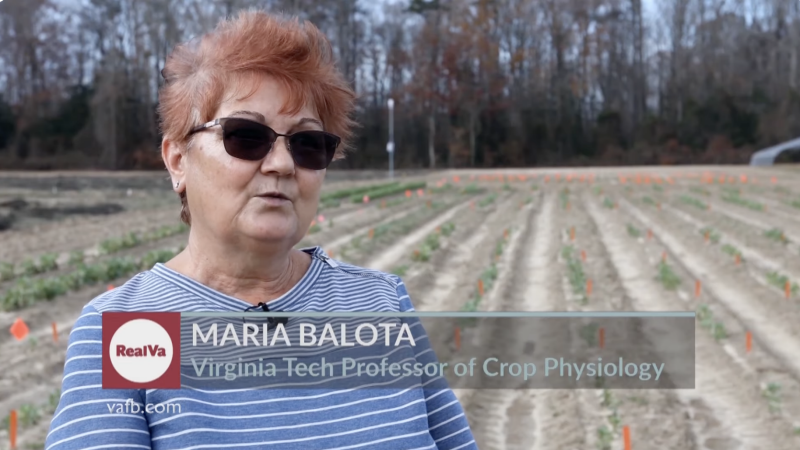
A woman wearing sunglasses and a striped shirt stands in a field of faba beans
Could Fava Beans Be Virginia's Next Agricultural Success Story?

For inquiries regarding the crop physiology program, please contact Professor Maria Balota at mbalota@vt.edu.

Pictured (L to R): Ph.D. students Keely Beard and Ranadheer Reddy Vennam, Extension Peanut Specialist Jacob Forehand, Crop Physiologist Maria Balota, Plant Pathologist David Langston, Graduate Student Pius Jjagwe, and Precision Ag Specialist Abhilash Chandel at the 2024 APRES meeting in Oklahoma City, OK.
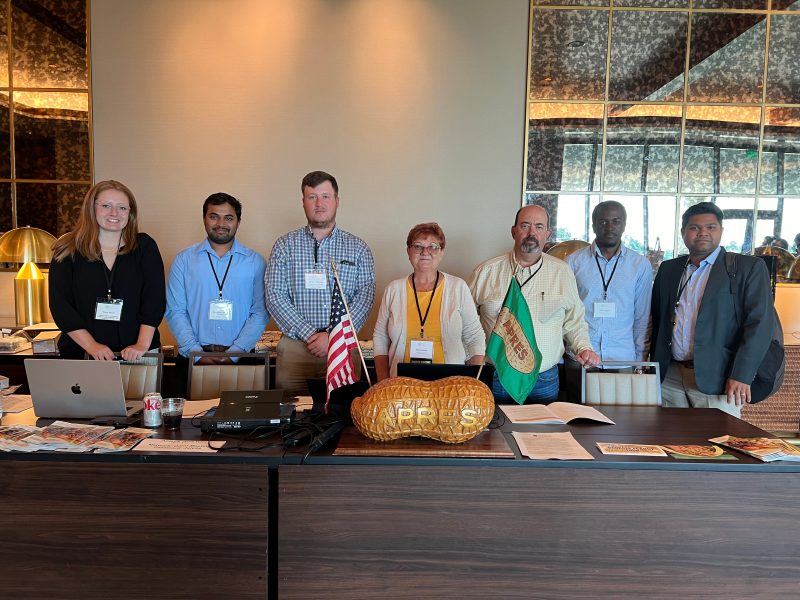
Group of faculty and students standing together behind table at APRES meeting in Oklahoma City, July 2024.
Pictured (L to R): Ph.D. students Keely Beard and Ranadheer Reddy Vennam, Extension Peanut Specialist Jacob Forehand, Crop Physiologist Maria Balota, Plant Pathologist David Langston, Graduate Student Pius Jjagwe, and Precision Ag Specialist Abhilash Chandel at the 2024 APRES meeting in Oklahoma City, OK.